

Reviewed · CITY TOURS
Self-Guided Audio City Tour in Zurich
Zurich’s old center packs a surprising number of stories into a small walking area. This self-guided route takes you from the main station to Lindenhof, Roman baths, Reformation churches, Cabaret Voltaire, Lenin’s former apartment, and the Opera House, all with an English audio track in your pocket. I like the freedom to stop, skip, or linger, and I like the low price, $13.29, for an introduction to the city.
The route also gives you useful city bearings, especially along the Limmat River and through the Old Town. The main drawback is the technology: you need your own phone, internet connection, headphones, and a healthy battery. The walk can take 3.5 to 4.5 hours if you listen carefully and pause at the sights, rather than the advertised 2 to 3 hours.
In This Review
- Key points to know before you walk
- Starting beside Zurich’s main station
- Lindenhof gives you the best pause
- Churches explain Zurich’s changing beliefs
- Old Town stories get stranger at Cabaret Voltaire
- Fraumünster is the one paid interior visit
- Statues and public art keep the route moving
- How long does the walk really take?
- Navigation and phone preparation matter
- What the $13.29 price buys you
- Who will enjoy this Zurich audio walk?
- Should you book this Zurich tour?
- FAQ
- Where does the Zurich audio tour start?
- Where does the tour end?
- How long does the tour take?
- What language is the audio guide offered in?
- Do I need my own phone and headphones?
- Is there a live guide?
- Is admission to Fraumünster included?
- Can I cancel the experience?
Key points to know before you walk
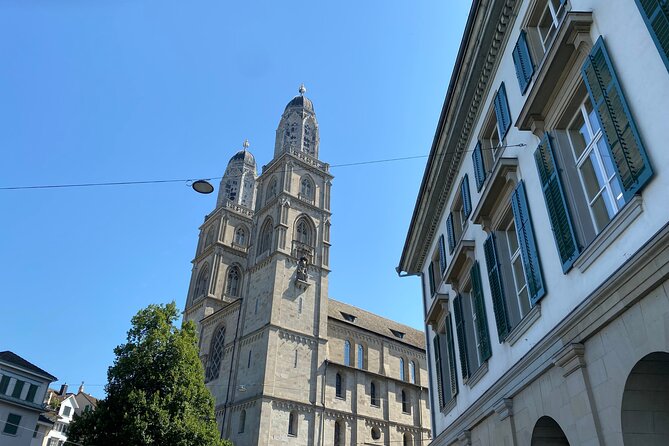
- A strong first look at Zurich: The route links the railway station, Old Town, riverfront, churches, financial district, and Opera House.
- History with plenty of variety: You’ll hear about Alfred Escher, Pestalozzi, Roman baths, the Reformation, Dada, Lenin, guilds, and public art.
- Fully self-paced: Skip a stop, pause the audio, take a detour, or spread the route across more than one day.
- Good navigation aids: Photos and written directions help, though a map app can be useful when street signs are hard to spot.
- Budget-friendly format: At $13.29 per person, the tour costs far less than a private walking tour, but you give up a live guide.
- Plan for your phone: Download or prepare the access link, bring headphones, and start with a full battery.
Starting beside Zurich’s main station
The walk begins at the Alfred Escher Statue on Bahnhofplatz, next to Zurich’s central station. This is a practical starting point because you can reach it easily by public transportation, and it lets the tour explain how railways helped shape modern Switzerland.
Alfred Escher was a politician, industrial organizer, and major force in the development of Swiss rail transport. His monument is not just another statue in a square. It introduces a basic Zurich theme: trade, finance, education, and transport all grew together here.
A few minutes later, the route reaches the Pestalozzianlage and its monument to Johann Heinrich Pestalozzi. Pestalozzi changed ideas about education and the treatment of children, so this stop adds a social side to the city’s story. It is brief, but useful if you want more than a parade of pretty buildings.
The Urania Observatory appears along the early part of the route as a reminder that Zurich also looks upward. The observatory’s position in the center makes the contrast appealing: busy city streets below, distant planets and stars above. The stop is primarily a sight to view from outside, so do not expect a scheduled observatory visit as part of this experience.
A few more Zurich trips to weigh up
- Zurich City Tour with Audio Commentary
★ 4.0 · 372 reviews - Einstein in Zurich: Walk in Time Exploration Game and Tour
★ 4.0 · 25 reviews - Self-Guided Audio Tour to the Dark Side of Zurich
★ 4.5 · 14 reviews
Lindenhof gives you the best pause

Lindenhof Hill is one of the route’s most rewarding stops. From this elevated park, you get broad views toward the Limmat River and the older quarters of Zurich. This is where I would pause the audio, take photographs, and get your bearings before moving into the tighter lanes of the Old Town.
The guide points out the Hedwig Fountain, the nearby Masonic Lodge, and the Tombstone of Lucius Aelius. Those details give the hill more depth than a simple lookout. You move from medieval and modern Zurich toward the city’s Roman past, with a few unusual stories along the way.
The allotted stop is only about 10 minutes, but you should not feel tied to that clock. The whole point of an audio tour is control. If the view is good, stop listening for a while. If you are visiting in poor weather, you can keep moving and return later because access remains available for a year after purchase.
Churches explain Zurich’s changing beliefs
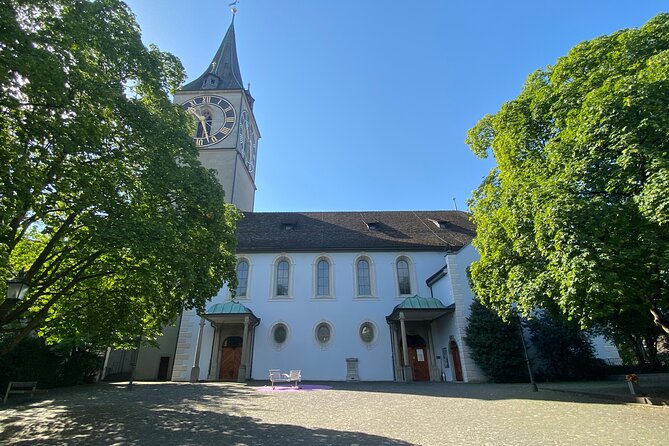
St. Peter’s Church comes next, with its huge clock face and long connection to Zurich’s parish life. The church is known for having one of Europe’s largest clock faces, an easy detail to appreciate from outside. Inside, you’ll find a quieter setting and centuries of religious use.
The route then takes you to Thermengasse, where traces of ancient Roman baths offer a small but important change of pace. You are not visiting a large Roman complex. Instead, you see archaeological remains woven into the present-day city, a useful reminder that Zurich’s story began long before its banking district and shopping streets.
The Town Hall follows, giving the audio a chance to discuss Zurich’s political past. This is a short stop, but it helps connect the city’s civic power with the grander churches and public monuments around it.
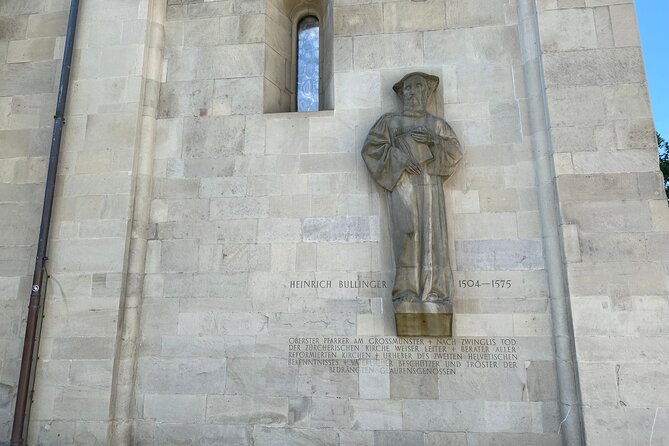
Grossmünster is the major church stop. Its twin towers are among Zurich’s most familiar sights, and its role in the Swiss Reformation makes it central to understanding the city. The audio explains the church’s connection to Ulrich Zwingli, the reformer who challenged Catholic practice and reshaped religious life in Zurich.
Inside, the stained glass by Augusto Giacometti adds a strong artistic contrast to the building’s older stonework. The windows bring color and modern artistic energy into a serious historic setting. Admission is listed as free for this stop, though normal visitor arrangements inside a church can vary.
Across the river, the Wasserkirche provides another look at Zurich’s religious architecture. Its stained-glass windows are the main visual feature highlighted by the guide. The stop is short, so it works well as a quick look before you continue along the river.
The Ulrich Zwingli Monument sits nearby. Seeing the reformer represented in public space helps make the earlier Grossmünster story more concrete. If church history is not your favorite subject, this portion may feel a little heavy. One useful feature of the audio format is that you can pause or skip sections without holding up a group.
Old Town stories get stranger at Cabaret Voltaire
Cabaret Voltaire is one of the route’s most distinctive stops. This was the birthplace of Dada, an art movement built around absurdity, protest, and a rejection of conventional artistic rules. The location gives the walk a welcome jolt after several churches and civic buildings.
You then visit the former Zurich apartment of Vladimir Lenin, who lived in the city during political exile. The stop does not require you to accept a particular political view. Instead, it places a major revolutionary figure in an ordinary urban setting and asks you to picture the ideas being worked out behind those walls.
These two stops show why a city walk should not stick only to famous monuments. Zurich’s identity comes from its religious reformers and financiers, but also from artists, political exiles, writers, and people who challenged accepted rules.
Same mountains, a completely different kind of day:
- Mount Titlis and Lucerne Day Trip from Zurich
★ 4.5 · 1,960 reviews - Heidiland and Liechtenstein Tour from Zurich
★ 4.0 · 1,745 reviews - Jungfraujoch: Top of Europe Day Trip from Zurich
★ 4.5 · 1,647 reviews - Jungfraujoch Day Trip from Zurich: Swiss Alps & Bernese Oberland
★ 4.5 · 1,409 reviews
Fraumünster is the one paid interior visit
Fraumünster Church is the route’s most important optional paid stop. The church is famous for stained-glass windows designed by Marc Chagall, whose work fills the interior with color and symbolic scenes. If you enjoy church art, this is one place where paying the CHF 5 entrance fee can make sense.
The tour price does not include that fee. You can still appreciate Fraumünster from outside and continue along the route without entering. That choice keeps the basic experience inexpensive, but you should budget the extra CHF 5 if the Chagall windows are a priority.
The audio also takes you through Paradeplatz, Zurich’s financial center. This is a useful contrast to the medieval lanes. Banks, luxury shopping, and modern commerce make clear how the city moved from river trade and guilds to international finance.
Augustinerkirche provides a quieter counterpoint. Its simple appearance and modest scale make it less dramatic than Grossmünster or Fraumünster, but that is part of its appeal. The church offers a short pause from the city streets and another piece of Zurich’s religious past.
Statues and public art keep the route moving
Not every stop is a major attraction, and that is both a strength and a limitation. The Max Bill Pavilion Sculpture on Bahnhofstrasse is a good example. It is an architectural work associated with ideas of transparency, equality, and freedom. The guide encourages you to consider how public art can express civic values without telling a literal story.
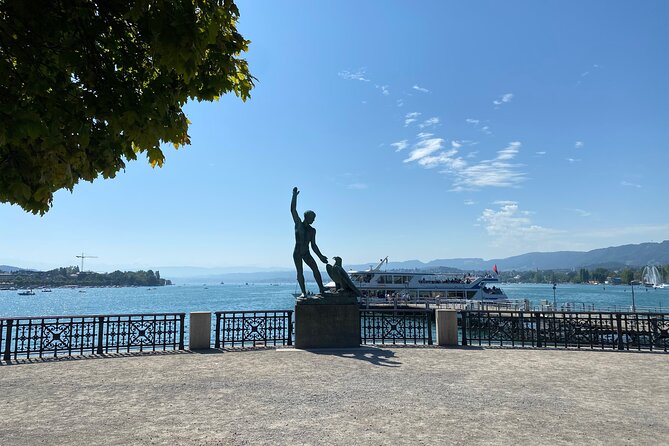
The Ganymed sculpture adds a mythological note. It connects Zurich’s streets with an old narrative about the figure Ganymede, giving you something unusual to look for amid the urban setting.
The Hans Waldmann Statue brings you back to local political history. Waldmann rose from modest origins to become Zurich’s burgomaster, then ended his life after being sentenced to death. The story has triumph, power, and tragedy, which makes the statue more memorable than a name and date alone.
At Weinplatz, the Millers’ and Bakers’ Guild Building gives the final section a look at working life. Guilds shaped Zurich’s economy and politics, and this building helps you picture the trades and social structures behind the city’s handsome old facades.
The advertised ending is beside Max Bill’s Pavilion Sculpture at Bahnhofstrasse 47. That is helpful because a clear endpoint makes it easier to plan the rest of your day. You finish in a central area rather than somewhere remote, although it is wise to check the final directions before setting off.
How long does the walk really take?
The stated duration is about 2 to 3 hours, but that assumes a brisk pace and limited sightseeing time. A careful audio walk can take 3.5 hours, while a leisurely visit with pauses, photographs, church interiors, and side trips can reach 4 to 4.5 hours.
The guide includes written captions as well as audio. That matters because you can read faster than the narration, revisit a section, or continue quietly when a recording becomes repetitive. One useful approach is to listen fully at the major stops, then skim the text for minor monuments.
The route is not a race. You can skip locations you have already seen and spend more time at Lindenhof, Grossmünster, or Fraumünster. Access is valid for one year after purchase, so you can also split the walk across separate visits instead of trying to finish it in one tired stretch.
Navigation and phone preparation matter
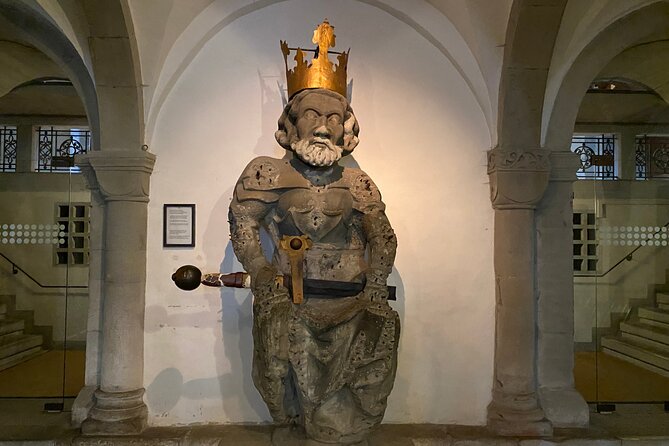
The directions include photos and clear route information, which can make the tour feel like a city scavenger hunt. You look for a statue, fountain, building, or architectural detail, then listen to the story attached to it.
Still, you should not rely on the audio alone. Some street signs may be difficult to see, and the route can become confusing in the Old Town. Keep a map app available, watch the battery level, and make sure your internet connection works before you leave the station.
The audio link is delivered after booking. Keep the confirmation email easy to find, and use headphones so you can hear the narration in city traffic. Technical trouble has occurred for some users, including playback resetting to the beginning or an access link failing to activate. That does not make the format unusable, but it does make preparation important.
Bring a portable battery if you have one. The phone handles the audio, directions, photos, and possibly your map, so a long walk can use more power than expected.
What the $13.29 price buys you
At $13.29 per person, this is a good-value orientation walk. You receive an English audio guide, route directions, photographs, and access to a long list of Zurich sights. Most stops have no admission charge, and you pay only if you choose to enter Fraumünster, where the fee is CHF 5 per person.
The tradeoff is simple. You save money and gain privacy, but you do not get a live guide who can answer questions, adjust the route, or explain a detail in the moment. If you want local conversation and a tightly managed two-hour walk, a live tour may suit you better.
I see this as an inexpensive first-day introduction, especially if you want to learn the city’s layout before choosing which museums or churches deserve more time. It also works well for independent walkers who dislike fixed schedules.
Who will enjoy this Zurich audio walk?
You are a good match for this tour if you like:
- Walking alone, with a partner, or with your own small group
- Historical background rather than only photo stops
- Choosing your own pace and skipping less interesting sections
- Exploring churches, monuments, public art, and unusual political stories
- Spending little while still seeing many central sights
- Reading a transcript when you do not want to listen continuously
You may want something else if you dislike phone-based tours, have limited mobile data, or prefer a guide who manages navigation for you. It is also not ideal if you have only one free hour. The route covers a lot of ground, and the best experience comes when you can stop without watching the clock.
Most people who can participate in a normal city walk should manage the route, but comfortable walking shoes are a smart choice. Service animals are allowed, and the starting and ending points are near public transportation.
Should you book this Zurich tour?
Book it if you want an affordable, flexible way to meet Zurich’s main central sights and understand the forces behind them. The mix is unusually broad: railway development, education, Roman archaeology, Reformation politics, Dada art, Lenin, guild trades, financial power, and modern sculpture.
I would especially recommend it for a first visit when you want to get your bearings fast without committing to a live group. Start early, charge your phone, keep a map ready, and allow at least three hours. If you want the Chagall windows, add the CHF 5 Fraumünster admission and extra time.
Skip it if you expect a polished live performance or dislike troubleshooting technology. At this price, the tour offers a lot, but the responsibility for navigation, timing, and equipment remains with you. That is a fair bargain for independent walkers, and a poor fit for anyone who wants every detail handled.
FAQ
Where does the Zurich audio tour start?
It starts at the Alfred Escher Statue on Bahnhofplatz, beside Zurich’s main station.
Where does the tour end?
It ends next to the Max Bill Pavilion Sculpture at Bahnhofstrasse 47 in Zurich.
How long does the tour take?
The approximate stated duration is 2 to 3 hours. If you listen carefully, pause at sights, and explore the churches, it can take 3.5 to 4.5 hours.
What language is the audio guide offered in?
The audio guide is offered in English.
Do I need my own phone and headphones?
Yes. You need your own mobile phone with internet access and a headset or headphones.
Is there a live guide?
No. This is a self-guided activity using an access link provided after booking.
Is admission to Fraumünster included?
No. If you choose to enter Fraumünster Church, the additional admission fee is CHF 5 per person.
Can I cancel the experience?
Yes. You can receive a full refund if you cancel at least 24 hours before the experience start time. Changes or cancellations made less than 24 hours in advance are not accepted for a refund.
Just added around Zurich
- Crash Landing on you Tour with Private Transportation★ 5.0 · 6 reviews
- Full-Day Private Zurich Sightseeing Tour and Chocolate Tasting★ 5.0 · 5 reviews
- Zürich, Lindt Chocolate, Rheinfalls and Stein am Rhein★ 5.0 · 14 reviews
- Day trip to Swiss Villages from Zurich – Small Group Tour by Car★ 5.0 · 8 reviews
- Zurich and Suroundings (Private Tour)★ 5.0 · 7 reviews
- Zürich: Private Car Tour to Rhine Falls, Titisee and Black Forest★ 3.5 · 4 reviews
- Zurich Airport Stress-Free Private Transfer★ 5.0 · 6 reviews
- Mount Titlis Cable Car with Ice Flyer and Lucerne from Zurich★ 4.0 · 14 reviews
City Tours, compared.
Best of Geneva City Tour with optional boat cruise
Read our review →
City tour Zurich with the city whispers from CHF 21.00
Read our review →

Best of Zurich and Surroundings – Extended City Sightseeing Tour
Read our review →
Private Arrival Transfer: from Zurich Airport to Zurich City
Read our review →
Browse the lists this tour appears in