
Reviewed · WALKING TOURS
Private 1.5-Hour Nightwatchman Walk in Medieval Lucerne
Lucerne’s old town can look polished by day. At night, with a costumed nightwatchman leading you through its lanes, the city takes on a stranger, more human character. You’ll hear the fire horn, study the 1597 Martini plan, and follow stories of crime, punishment, ghosts, builders, merchants, and city law.
I like the private format, since your guide can keep the pace suited to your group. I also like the clever use of a small projector, which brings old paintings and medieval scenes into the streets instead of leaving you to picture them from a dry lecture. The main drawback is price: at $165.26 per person, it makes the most sense for a group that values a personal guide and shared cost.
In This Review
- Key points to know before you book
- Why Lucerne works so well after dark
- Starting at Peterskapelle and the Martini plan
- The Water Tower and Chapel Bridge
- Furrengasse, Kapellplatz, and the Toggeli
- Kornmarkt and the old city’s official measures
- Brandgässli and Weinmarkt’s painted façades
- Law, punishment, and the riverside at Zöpfli
- Reussbrücke, Spreuerbrücke, and the Needle Dam
- The old pharmacy window and guardian demons
- Ritterscher Palace and the Dance of Death
- The Jesuit Church and the final Chapel Bridge crossing
- What the private format is worth at $165.26
- Who will enjoy this walk most
- Timing, weather, and practical planning
- Should you book the Nightwatchman Walk?
- FAQ
- How long does the Nightwatchman Walk last?
- Where does the tour begin?
- Where does the tour end?
- Is this a private tour?
- What language is the tour offered in?
- Is the guide dressed as a nightwatchman?
- Are entrance tickets included?
- Does the tour run in bad weather?
- Is the tour suitable for most people?
- Can I cancel for a refund?
Key points to know before you book
- A real medieval character leads the way: Your professional guide wears a nightwatchman costume and uses props, stories, and a projector.
- The 1597 Martini plan gives the walk a clear thread: You compare Lucerne’s first city map with buildings that still survive.
- You see Lucerne’s famous sights with added context: The route includes Peterskapelle, Chapel Bridge, the Water Tower, the Jesuit Church, and the Musegg Wall area.
- The stories are not all gentle: Expect tales of torture, interrogation, corporal punishment, ghosts, and the Toggeli, a medieval night spirit.
- The tour is built for your group alone: It runs about 1.5 hours from April through October and about one hour from November through March.
- Night weather matters: The walk operates in all weather, so good shoes and proper layers are part of the deal.
Why Lucerne works so well after dark
The appeal here is not simply seeing Lucerne’s postcard sights. You are given a way to read them.
By day, Chapel Bridge is usually the star. At night, it becomes one piece of a larger story about a walled, trading city with strict rules and uneasy neighbors. The Water Tower, old guild signs, painted façades, narrow lanes, and river bridges begin to make sense as parts of a working medieval town.
The nightwatchman role helps set the mood without turning the tour into a stage show. The guide’s costume, the opening fire horn, and the old prayers create a sense of time and place. Then the presentation settles into history, local legends, and close looks at details that are easy to miss on an ordinary stroll.
This is especially useful if you have already walked through the old town and felt you had seen it all. The route points out symbols, murals, measures, building changes, and bits of street lore that can pass unnoticed when you are simply moving from the train station to Chapel Bridge.
A few more Lucerne trips to weigh up
- Lucerne Walking & Boat Tour: The Best Swiss Experience
★ 4.5 · 417 reviews - Exclusive Private Lucerne Walking Tour with Local Guide 3 Hours
★ 5.0 · 80 reviews - 1.5-Hour Small-Group Nightwatchman Walk in Medieval Lucerne
★ 4.5 · 34 reviews
Starting at Peterskapelle and the Martini plan
The walk begins at Rosengart Platz and quickly reaches Peterskapelle, or St. Peter’s Chapel. This is a strong opening stop because it combines ceremony, architecture, and a useful visual guide to the city.
You hear the fire horn, followed by an invocation prayer, then the nightwatchman explains what his work meant in medieval Lucerne. It was not a romantic job. A nightwatchman had to stay alert, watch for fire, and help protect the city while most people slept.
The guide uses a projector to introduce medieval Lucerne and show the Martini plan, the city’s first map, dating from 1597. This is one of the tour’s best teaching tools. You can follow the route on the map and see that many of the buildings marked there are still present today.
Peterskapelle itself dates to the 12th century and is described as Lucerne’s first church. Nearby is the city’s first private stone house. The guide connects that building to the expression stone rich, a small language lesson that makes an old wall feel unexpectedly personal.
The chapel stop lasts about 10 minutes. Admission is not included, so you should not expect an interior visit as part of the standard price. The value comes from the exterior setting and the explanation of how this area fits into Lucerne’s early development.
The Water Tower and Chapel Bridge
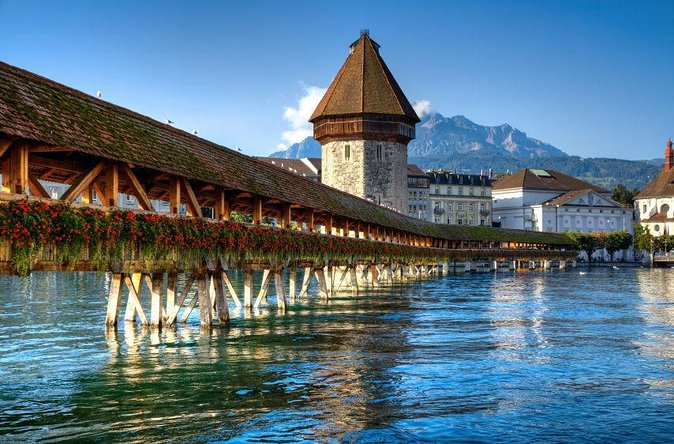
From Peterskapelle, the walk reaches Lucerne’s best-known pair of landmarks: the Water Tower and Chapel Bridge.
The guide corrects a common assumption here. The Water Tower came first, built in the late 13th century. Chapel Bridge followed in 1365. You see projected images of the Water Tower’s interior and hear about its torture chamber, dungeon, and secret room.
That material gives the tower a darker identity than its familiar waterfront appearance suggests. It was not just a picturesque structure beside the river. It also formed part of the city’s defenses and systems of confinement.
You also learn how Chapel Bridge got its name. Later, when you cross the bridge near the end of the walk, the guide explains why it was built diagonally across the river and points out its interior paintings.
The bridge stop is free and lasts about 10 minutes. The tour does not require an admission ticket for this section. If your main interest is entering the Water Tower, check what is available separately, since this experience shows projected images rather than promising an interior visit.
Furrengasse, Kapellplatz, and the Toggeli
The route turns toward Kapellplatz and Furrengasse, where the focus shifts from stonework to daily life and folklore.
You hear about Lucerne during its years as a flourishing republic and get a sense of how public spaces functioned in the Middle Ages. The guide also tells the story of a ghost associated with Furrengasse and the Toggeli, an incubus-like figure sometimes described as a love robber.
This is where the walk earns its night timing. Ghost stories can sound flat in a bright afternoon crowd. In a quieter lane after dark, they add just enough unease to make you look twice at the surrounding façades.
The stop lasts about 10 minutes and is outdoors. The story-focused sections are likely to appeal most to families with older children and teenagers, especially those who prefer legends and odd local customs alongside dates and architecture.
Same mountains, a completely different kind of day:
- Mount Pilatus Summit from Lucerne With Lake Cruise
★ 4.5 · 1,260 reviews - Jungfraujoch Top of Europe Day Trip from Lucerne
★ 4.5 · 840 reviews - Lake Lucerne Panoramic Sightseeing Cruise
★ 4.5 · 363 reviews - Mt Titlis Cable Car from Engelberg with Ice Flyer
★ 4.5 · 290 reviews
Kornmarkt and the old city’s official measures
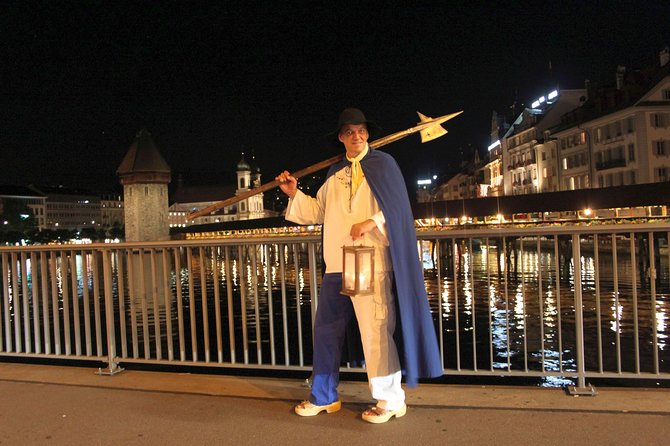
At Kornmarkt, the town hall square, the guide turns to civic life.
You see the Renaissance Town Hall and its tower, including a clock without a minute hand. That small feature opens a window onto a period when public timekeeping worked differently from the precise displays you carry in your pocket.
The guide also tells the story of the Giant of Reiden and shows the Lucerne foot and elle, the official measures used in old Lucerne. These are the sort of details that make history practical. They tell you how a city governed trade, set standards, and gave people common units for buying and selling.
Admission is not included at this stop, though the tour’s main presentation takes place along the route. Allow about 10 minutes here. It is a good stop for anyone who likes the nuts and bolts of old city life, not just famous buildings.
Brandgässli and Weinmarkt’s painted façades
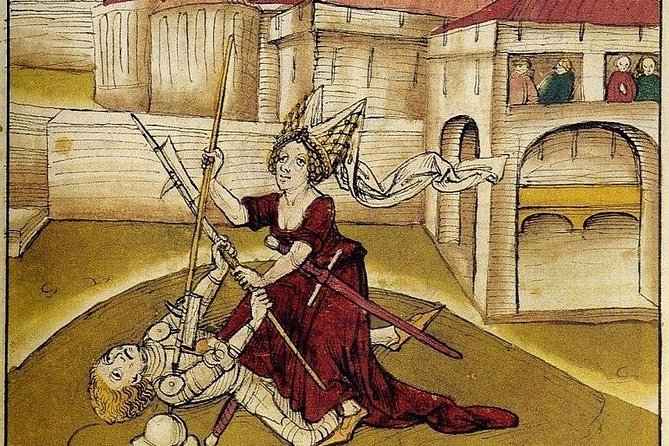
In Brandgässli, the guide tells you about a riot in Lucerne before leading you toward the former fish market, now known as Weinmarkt.
The shift from fish market to wine market reflects how city spaces change their purpose while retaining old names and physical clues. You are not simply passing through a pretty square. You are following the working life of the town, including conflict, commerce, and public gathering.
At Weinmarkt, look up. The old guest-house signs and painted façades are major visual highlights. The guide also points out the former pharmacy of Renward Cysat, where you can read the Latin phrase Amor medicabillis nullis herbis, meaning there is no cure for a broken heart.
This is a particularly good section for visitors who enjoy Lucerne’s painted architecture but want more than a quick photo. The stories give the signs and murals a reason to exist.
Law, punishment, and the riverside at Zöpfli
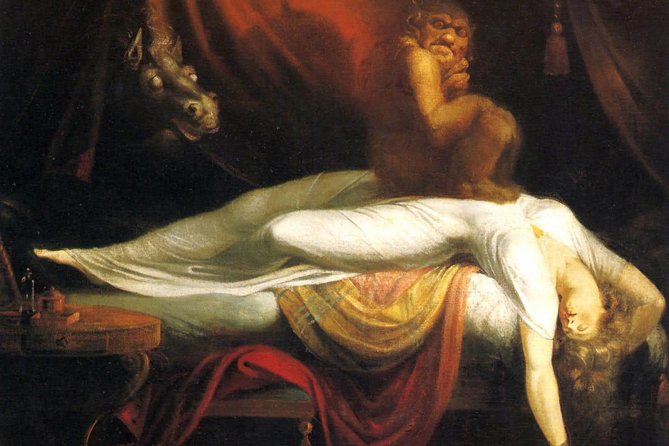
At the riverside square called Im Zöpfli, the subject becomes law and order.
The projector returns, this time showing paintings connected with medieval prosecution, interrogation, and corporal punishment in Lucerne. This is not the softest part of the walk, and families with young children may want to judge their comfort level.
The stop also adds balance to the romantic image of medieval Europe. Alongside chapels, bridges, and colorful houses, there were harsh legal systems and public methods of punishment. The nightwatchman’s stories help you understand how authority worked in a small city where reputation, obedience, and public order mattered.
You spend about 10 minutes here. The square’s river setting gives the presentation a break from narrow lanes, but the content remains serious.
Reussbrücke, Spreuerbrücke, and the Needle Dam
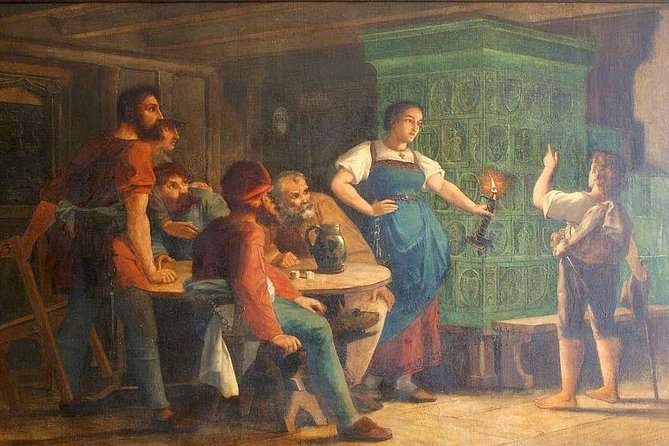
Crossing Reussbrücke brings several important pieces of Lucerne into view.
You see Spreuerbrücke, also called the Mill Bridge, the Needle Dam, and portions of the Musegg Wall. This is a compact lesson in how Lucerne used its river for defense, transport, milling, and water control.
The stop is free and takes about 10 minutes. You may not study each structure at close range, but the guide helps you understand how they relate to one another. That wider view is valuable because Lucerne’s bridges and walls can otherwise seem like separate sights scattered around the old town.
The river also gives the walk a welcome change of pace. After the close lanes around Kornmarkt and Weinmarkt, the open water helps you get your bearings.
The old pharmacy window and guardian demons
A few steps farther, you reach the medieval pharmacy window of the Alte Suidtersche Apotheke.
The window is one of the more unusual visual stops on the route. Rather than focusing only on grand churches and bridges, the guide brings you to a surviving piece of everyday commercial history. Admission is not included, so plan on viewing the exterior rather than treating this as a standard museum visit.
The nightwatchman then introduces guardian demons and the legendary house of Lux Ritter. You learn why the first two floors look different from the third and hear the story of Hans von Trient, an unlucky stonemason.
These details show how much of the tour’s appeal lies in close observation. The buildings are not presented as anonymous old walls. Their changes, symbols, and legends become clues.
Ritterscher Palace and the Dance of Death
The Ritterscher Palace section is one of the tour’s most theatrical moments.
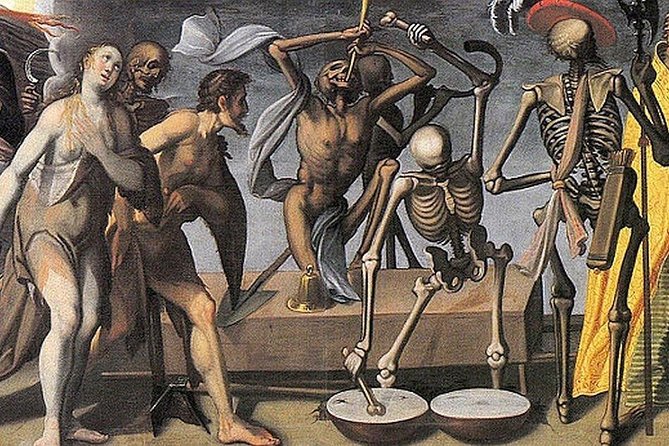
Here, the guide presents seven paintings from the Dance of Death on a house wall with the projector. You hear the story behind the images and learn more about the building associated with Lux Ritter.
The Dance of Death theme is a medieval reminder that death could claim anyone, regardless of rank. Projecting the paintings onto an old wall is a smart choice because it lets you see the images in the same kind of urban setting where public lessons and warnings once carried force.
This portion is especially suited to adults and older children who enjoy medieval art, symbolism, and darker historical subjects. It also gives the guide room to use props and character work, rather than delivering a standard list of dates.
The Jesuit Church and the final Chapel Bridge crossing
The walk passes the Church of the Jesuits, built in 1677 and described as Switzerland’s first Baroque building. It is a useful reminder that the route is not limited to the Middle Ages. Lucerne’s old town contains layers from different periods, and the guide places the later church within that larger story.
You finish by crossing Chapel Bridge. Now the bridge should feel less like an isolated photo stop and more like a structure with a reason for its diagonal shape, a name with a history, and paintings worth looking at as you walk.
The tour ends back at the starting point. The final bridge crossing gives the walk a neat visual return, rather than leaving you in a different part of the city.
What the private format is worth at $165.26
The listed price is $165.26 per person, with group discounts available. That is a considerable sum for a walking tour, especially if you are booking for only one or two people.
The calculation improves for a family or private group that wants a guide to itself. You avoid being folded into a large public group, and the guide can respond to your interests, questions, and walking pace. The tour also includes a professionally costumed local guide, some postcards of old Lucerne, and taxes and handling charges.
The value is strongest if you care about interpretation. You are paying for the character-led presentation, the projected images, and the local stories, not for entrance to a major museum or a long list of included attractions.
The tour lasts about 1 to 1.5 hours. From November through March, the duration is about one hour. That shorter winter format may suit you if you dislike extended outdoor walks in cold weather, but it also means less time for the full route and storytelling.
Who will enjoy this walk most
I would choose this experience for:
- Families with children around their early teens and older
- Couples who want an atmospheric evening walk
- History fans who like local stories and small details
- First-time visitors who want help reading Lucerne’s old town
- Repeat visitors who have already seen the major sights
- Private groups willing to pay more for a personal guide
The experience may be less suitable if you want a formal architectural lecture, a museum-heavy evening, or a low-cost group tour. Some stories involve torture, punishment, ghosts, and death, so consider the subject matter before bringing very young children.
The guide’s English is reported as excellent, and the presentation depends on clear storytelling. The guide named in the supplied information is Rolf, although one reference uses Ralph, so you may want to confirm the assigned guide when booking if that matters to you.
Timing, weather, and practical planning
The meeting point is Rosengart Platz, 6004 Luzern, and the tour returns there. It is near public transportation, though the experience itself is a walking route through the old town.
Wear shoes suited to city streets and dress for the forecast. The tour operates in all weather, and the night setting can feel colder than a daytime stroll. Rain did not prevent the presentation from working well, but a waterproof layer will make the evening easier.
The experience accepts mobile tickets, allows service animals, and most people can participate. Confirmation arrives at booking. Free cancellation is available if you cancel at least 24 hours before the start time. Changes or cancellations inside that window are not accepted for a refund.
Because the tour averages 107 days of advance booking, I would reserve early if your dates are fixed, especially for a private evening slot.
Should you book the Nightwatchman Walk?
Book it if you want Lucerne’s old town explained through people, legends, rules, and odd details rather than only dates and monuments. The 1597 map, projected artwork, old measures, pharmacy window, guardian demons, and Dance of Death presentation give the route a clear personality.
I would skip it if the $165.26 per-person price feels too high for an outdoor walk or if you prefer to explore independently with a guidebook. For a private family group, history-minded couple, or small party that wants a memorable evening with a strong local character, the cost can be justified. Just bring weather-ready clothing and expect a few unsettling stories along with the pretty bridges.
FAQ
How long does the Nightwatchman Walk last?
The tour lasts approximately 1 to 1.5 hours. During winter, from November through March, it lasts about one hour.
Where does the tour begin?
The meeting point is Rosengart Platz, 6004 Luzern, Switzerland.
Where does the tour end?
The activity ends back at the meeting point.
Is this a private tour?
Yes. Only your group participates in the private activity.
What language is the tour offered in?
The tour is offered in English.
Is the guide dressed as a nightwatchman?
Yes. A professional local guide leads the walk in medieval-style nightwatchman clothing.
Are entrance tickets included?
The tour includes taxes, fees, and handling charges, but admission tickets are not included for stops where an admission charge may apply. Several outdoor stops are free.
Does the tour run in bad weather?
Yes. It operates in all weather conditions, so you should dress appropriately.
Is the tour suitable for most people?
Most people can participate. The experience is near public transportation, and service animals are allowed.
Can I cancel for a refund?
You can receive a full refund if you cancel at least 24 hours before the experience start time. Cancellations or changes made less than 24 hours in advance are not accepted for a refund.
Just added around Lucerne
- Private Transfer: Lucerne to Zurich Airport ZRH by Luxury Van★ 4.5 · 6 reviews
- Private Transfer: Lucerne to Zurich Airport ZRH by Business Car★ 5.0 · 11 reviews
- Weggis Vitznau Foxtrail Helios★ 4.5 · 8 reviews
- The Lives and Legends of Lucerne: A Self-Guided Audio Tour★ 5.0 · 6 reviews
- Touristic highlights of Lucerne on a Private half day tour with a local★ 4.0 · 5 reviews
- Tandem Flight Zurich-Engelberg★ 5.0 · 7 reviews
- Paragliding Tandem in Switzerland★ 5.0 · 9 reviews
- Panoramic E-Bike Tour with a Lake Cruise★ 5.0 · 10 reviews
Walking Tours, compared.

Zurich Walking Tour With Cruise and Aerial Cable Car
Read our review →
Lucerne Walking & Boat Tour: The Best Swiss Experience
Read our review →
3 in 1: Zurich Walking Tour – Cruise on the Lake – Cable Car Ride to Felsenegg
Read our review →
Glacier 3000 Ticket Including Cable Car and Peak Walk by Tissot
Read our review →

Bern Walking Tour: Explore Top Sights & Hidden Gems
Read our review →Browse the lists this tour appears in